


Keeping an eye on the big picture often means looking beyond our own backyard – and even beyond Earth!
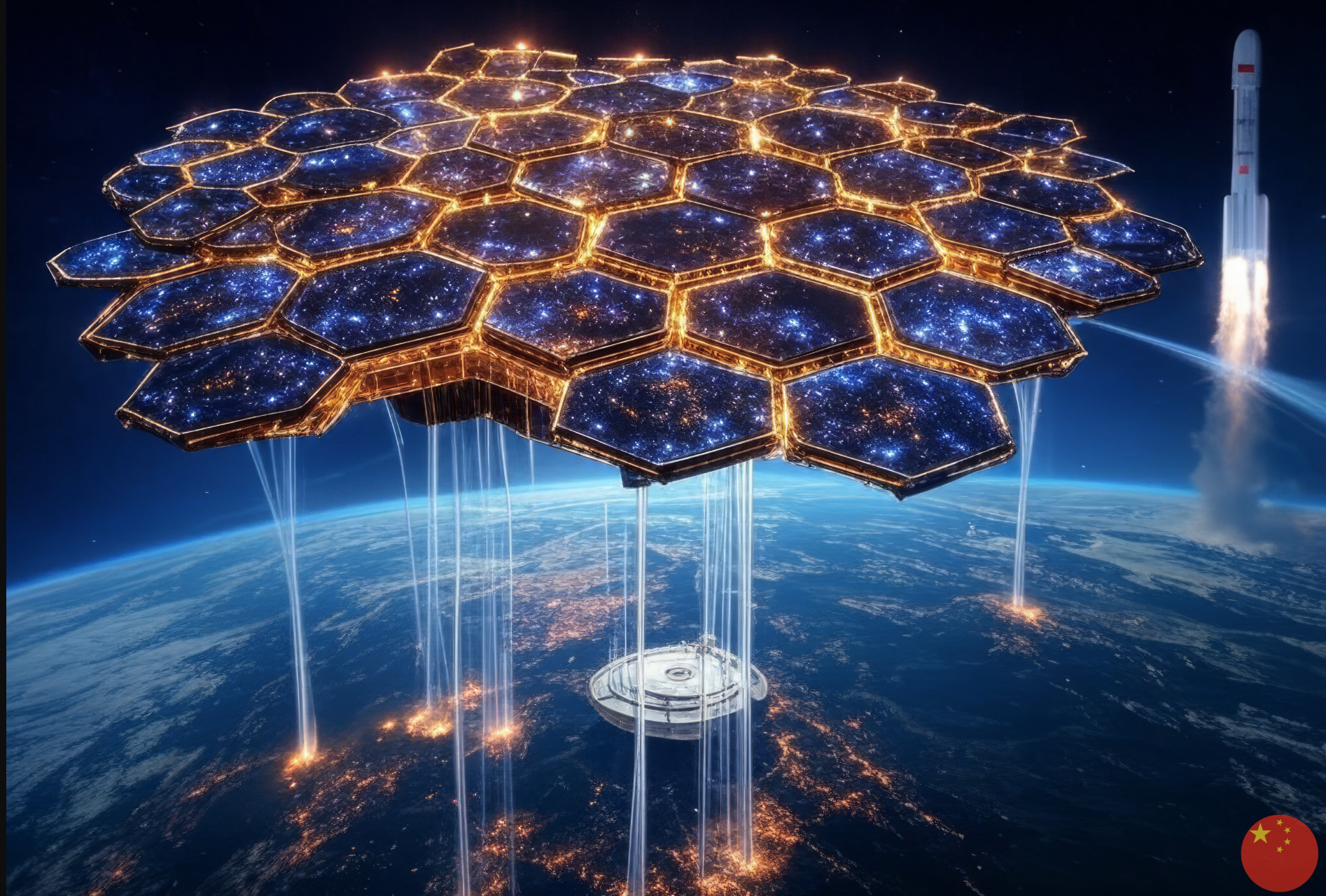
Geopolitical analyst James Wood, who writes extensively about China, recently highlighted one of the most ambitious renewable energy projects on the planet (and above it): a solar space station.
His post offers fascinating insight into how China’s innovation could shape not just the global energy landscape, but the world economy too. Here’s his post in full:
China is making the once sci-fi dream of space based solar power (SBSP) a reality and leaving the West scrambling to keep up.
Imagine a kilometre wide solar array orbiting Earth, harvesting limitless, uninterrupted solar energy and beaming it back home, day and night, without the interference of clouds or darkness.
The China Academy of Space Technology (CAST) is spearheading this geostationary solar power station and with a 2028-2050 roadmap, Beijing is set to redefine the global energy game.
The Master Plan
2028: China launches a 400-km low Earth orbit (LEO) test satellite generating 10 kilowatts (kW) to trial microwave power transmission. Think DFH-4E satellite tech, on steroids.
2030: A 1-megawatt (MW) station is deployed in geostationary orbit (GEO) at 36,000 km, where it will be assembled in space before beaming power back to Earth.
2035: The system scales up to 10 MW, proving its potential for mass energy production.
2050: The final form, a 2-gigawatt (GW) space solar farm, rivaling nuclear power plants and capable of supplying electricity to millions of homes.
How It Works
Unlike Earth based solar farms, which suffer from weather conditions and nighttime dips, a solar station in space captures continuous, unfiltered solar radiation, 10 times more efficient than anything on the ground.
The energy is then converted into microwaves and beamed down to terrestrial receiving stations, where it is transformed back into electricity and integrated into the grid.
The Bishan testing facility in Chongqing, backed by $15 million in funding, is already fine tuning the radio wave transmission tech needed to transmit solar energy from orbit to Earth.
Why China Is Leading This Race
This isn’t just ambition, it’s execution.
China has been pumping billions into SBSP since the early 2000s, with CAST, Chongqing University and Huawei leading research efforts.
The country’s state driven, centralised approach allows for massive coordination and rapid development, unlike the fragmented, slow moving private sector initiatives in the U.S.
Compare this to the U.S., where NASA’s flirtation with SBSP died post-Apollo and Google’s renewable bets (like Makani wind kites) remain Earth bound pipe dreams.
China’s Long March 9 rocket will be hauling this behemoth into space, while the U.S. relies on SpaceX’s pricier, less coordinated private launches.
The Stakes: More Than Just Energy
If China nails this, it’s not just a clean energy breakthrough, it’s geopolitical dominance. A functional space-based power station would:
✅ Reduce dependence on fossil fuels
✅ Secure national power grids
✅ Provide energy for space and military assets
Meanwhile, the U.S. lags behind, bogged down by private sector fragmentation, underfunded agencies and a lack of long-term vision.
While China accelerates towards its 2060 carbon neutrality goal, the West is still debating the feasibility of such a project.
To be clear, challenges remain, from microwave precision to orbital assembly logistics, but China’s commitment and pace are undeniable. The West is watching and it’s nervous.
This isn’t just China making history, it’s China shaping the future. China is literally turning Science Fiction to fact and China is most certainly not the villain of the story.
Source: https://x.com/commiepommie/status/1898361006231113879


